
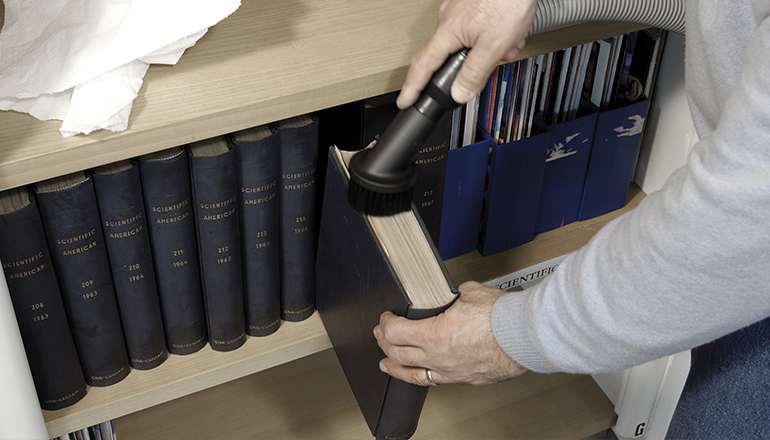
The presence of dust in books is an unavoidable reality in libraries, archives and documentation centres. In high-density storage environments, the gradual build-up of dust on books and shelves can affect the condition of the materials and the healthiness of the environment.
The professional cleaning of books forms part of the preventive conservation processes for book and archival collections. Regular and effective cleaning helps to keep dust accumulation under control and safeguard knowledge.
Why dust is a problem for book and archival collections
In libraries, archives, book depositories and documentation centres, dust is one of the main factors contributing to the progressive deterioration of collections. In high-density storage environments, large quantities of books and documents are kept on shelves for long periods, encouraging the gradual accumulation of dust on the volumes and within the storage areas.
Under these conditions, dust management requires ongoing operational activities and systems designed to handle large quantities of materials, whilst maintaining control over the treatment and the safety of the volumes.
Accumulation is mainly caused by:
- Poor ventilation
- Enclosed spaces
- High density of books and shelving
- The continuous presence of people in the spaces
In book storage areas, dust tends to build up progressively on the external surfaces of the volumes and on the shelves. The constant presence of dust can affect:
- The conservation conditions of the materials
- Indoor air quality
- The operational management of the collections
For this reason, dusting activities require structured and scheduled interventions over time.
Where does dust settle in books? Differences between external and between-page cleaning
Dust accumulates mainly on the external surfaces of books. Approximately 60% of the accumulation affects the top edge, the part most exposed during storage on the shelf, whilst the remaining 40% is distributed between the book’s covers, front edge and spine.
The accumulation also varies depending on the arrangement of the books and the differences in format between volumes stored side by side. Differences in height and depth create exposed surfaces and level differences that encourage dust to settle.
This distribution forms the basis for automated dusting of book collections. External cleaning systems target the areas where dust tends to accumulate most heavily. The spine is generally excluded from automated dusting processes as it is the most delicate part of the binding.
Internal cleaning between the pages, however, follows a different logic and must be reserved for specific cases:
- Antique books
- Valuable volumes
- Fragile materials or those in poor condition
- Actual presence of internal residues
In these cases, the procedure is carried out manually using vacuum stations and tools compatible with the conservation requirements of the material.
For the conservation of book collections, dusting the external surfaces is therefore the primary preventive measure.
How to clean dust from books in professional settings
In professional settings, such as libraries and archives, cleaning must ensure the safety of the collections and minimise handling. As seen above, removing dust from books requires a preliminary assessment of the materials, as well as a distinction between:
- External dusting
- Manual between-the-pages cleaning
Operating procedures vary depending on the type of material, format, state of preservation and frequency of use of the collections.
The great advantage of Oracle’s professional solutions lies in the specialisation of the systems rather than in a single general-purpose machine. Different technologies for different treatment needs: cleaning, disinfection and conservation. Even in professional dusting, the various machines dedicated to cleaning meet specific operational requirements.
For large book collections, automated systems such as Depulvera enable high-volume dusting at a rate of 12 books per minute. During the process, the book is supported by the page edges and automatically rotates 180° to ensure uniform external cleaning. The removed dust is extracted via HEPA-filtered systems, minimising dispersion into the environment.
For day-to-day library activities and smaller collections, compact systems such as Pulvisina can be used, designed for frequent and recurring operations.
For the treatment of periodicals, archival documents and oversized materials, dedicated systems such as L’aura are recommended.
When conservation requirements necessitate intervention inside the book, intra-leaf operations are carried out manually using suction stations and tools compatible with the materials, such as soft brushes, dry microfibre cloths and controlled suction systems. In these contexts, dedicated stations such as Spirabilia are used, developed for antique books, manuscripts and fragile materials.
How often should books be dusted in libraries and archives
Dusting of collections should be scheduled at least once a year (on average between 6 months and 2 years), depending on environmental conditions, the density of the collections, the frequency of material consultation and the ventilation of the storage areas.
The cleaning of library materials is often planned in conjunction with:
- Relocations
- Relocation of collections
- Reorganisation of shelves
- Work on storage environments
When dusting is integrated into existing operational activities, it allows for work to be carried out on the volumes during the handling phases.
With Oracle technologies, it is even simpler, because they are based on a powerful principle: bringing the machine to the book, not the book to the machine. Working directly near the shelves reduces unnecessary handling of the collections, minimising operational time and the risk of damage to the materials.
How to protect books from dust over time
Caring for our book and document heritage is essential for the future, all the more so in contexts dedicated to preserving knowledge, such as libraries and archives.
This is why it is even more important to understandhow to clean and protect books from dust:
- Monitoring environmental conditions
- Selecting professional cleaning equipment
- Monitoring humidity and ventilation
- Reducing stagnant air in enclosed spaces
- Regular cleaning of collections
- Monitoring shelves and storage areas
- Using filtered vacuum systems suitable for library materials
Dust is one of the factors that can affect conservation conditions, as discussed in detail in the article on the main factors causing the deterioration of library and archival materials; humidity, temperature fluctuations, mould and exposure to light also contribute to the progressive deterioration of collections.